



The world is witnessing a major transformation thanks to the rapid development of artificial intelligence technologies, as these technologies have become an essential part of various economic and commercial sectors. Therefore, understanding artificial intelligence and its impact on the future of entrepreneurship has become a necessity for every entrepreneur seeking to develop their project and increase their competitiveness. Artificial intelligence is not limited to automating tasks; it also contributes to improving decision-making, analyzing data, developing services, and innovating new business models that help projects grow faster and more efficiently.
Artificial Intelligence and its Impact on the Future of Entrepreneurship
Artificial intelligence and its impact on the future of entrepreneurship represent a real turning point in the way projects are managed, because it provides entrepreneurs with advanced tools that help them improve performance, reduce costs, and increase productivity, which directly reflects on the success and sustainability of the project:
-
Artificial intelligence helps automate many repetitive tasks, giving business owners the opportunity to focus on planning, development, and strategic decision-making.
-
It also contributes to analyzing large amounts of data in a short time, which helps in understanding the market, customers, and competitor trends more accurately.
-
Artificial intelligence applications can be used to improve customer service through smart responses, analyzing customer needs, and providing quick and effective solutions.
-
Relying on artificial intelligence also gives small and medium-sized enterprises the opportunity to compete with large companies by leveraging modern technologies at lower costs compared to traditional methods.
Improving Decision-Making
One of the most prominent aspects that illustrate artificial intelligence and its impact on the future of entrepreneurship is its ability to support the decision-making process, as it relies on analyzing various data and indicators to provide information that helps business owners choose the best available alternatives:
-
Artificial intelligence analyzes financial, operational, and marketing data, which helps management discover opportunities and challenges before they become clearly apparent.
-
It can also predict future demand and customer behavior, which helps in planning production, inventory, and marketing more accurately.
-
Smart analytics help reduce the rate of random decisions, because all recommendations are based on actual data and statistics rather than personal expectations.
-
Artificial intelligence also gives entrepreneurs the ability to make faster and more efficient decisions, which helps the project respond quickly to market changes and achieve a competitive advantage.
Improving Customer Experience
Improving customer experience is one of the most important aspects that illustrate artificial intelligence and its impact on the future of entrepreneurship, because the success of any project depends largely on its ability to understand customer needs and provide services that meet their expectations quickly and efficiently:
-
Artificial intelligence helps analyze customer behavior and preferences, enabling the project to provide personalized offers and services that accurately suit each customer's needs.
-
Smart chatbots also contribute to responding to customer inquiries around the clock, which improves the level of service and reduces waiting time.
-
Smart systems can analyze customer reviews and opinions to discover strengths and weaknesses, which helps management continuously develop products and services.
-
Improving customer experience also leads to increased loyalty rates and repeat purchases, which directly reflects on the project's growth and increased profits.
Increasing Productivity and Reducing Costs
One of the most prominent manifestations of artificial intelligence and its impact on the future of entrepreneurship is its ability to increase operational efficiency and reduce expenses, because relying on smart systems helps accomplish work with greater speed and accuracy compared to traditional methods:
-
Artificial intelligence can be used to automate many administrative processes such as data entry, report preparation, and inventory management, which reduces the time and effort required to complete these tasks.
-
It also helps reduce human errors that may lead to financial losses or operational problems, which improves work quality and increases performance efficiency.
-
Relying on smart analytics leads to better resource utilization, reduced waste, and increased employee productivity, as they are freed up for tasks that require thinking and creativity.
-
Lowering operational costs while increasing productivity gives the project a greater ability to compete and achieve sustainable growth in various markets.
Artificial Intelligence and Innovating New Business Models
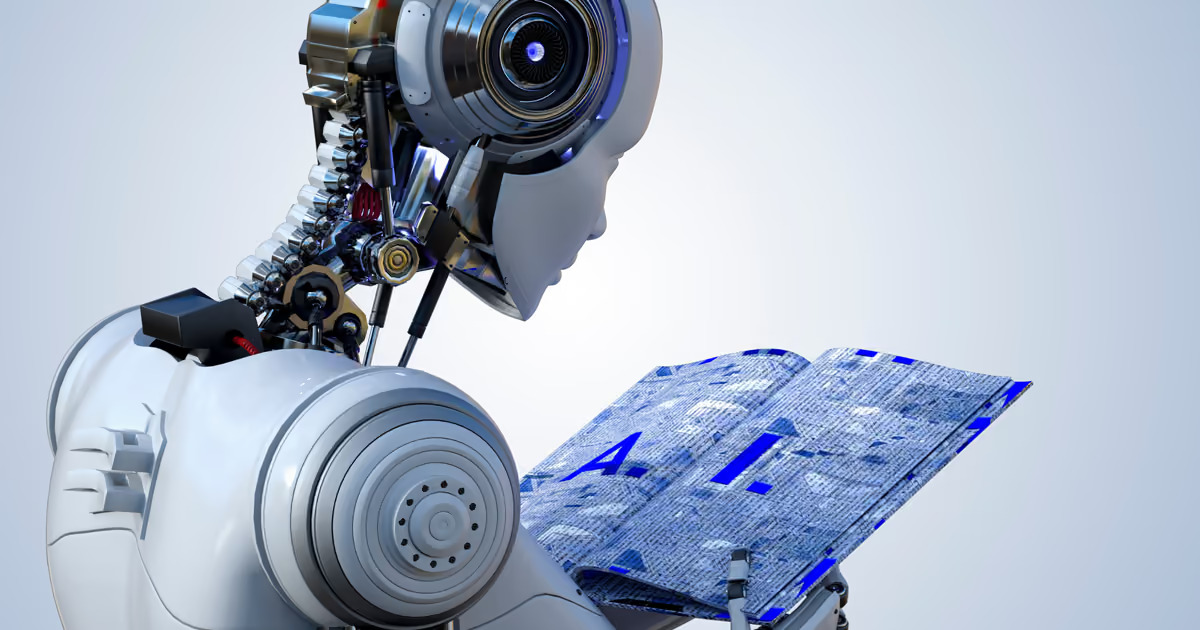
Artificial intelligence and its impact on the future of entrepreneurship contribute to the emergence of new business models that were not possible in the past, as entrepreneurs can now provide services and products based on smart analysis and data, which opens up vast investment opportunities in various sectors:
-
Artificial intelligence helps develop digital services based on personalization, so that each customer gets an experience that suits their needs and behaviors, which increases the value provided by the project.
-
It also allows for the creation of products based on predictive analysis, such as smart recommendations, market analysis, and risk management, which are services that have become in demand in many fields.
-
It gives startups the opportunity to enter new markets faster by relying on technical solutions instead of traditional expansion that requires huge investments.
-
Continuous innovation in the use of artificial intelligence helps projects build a competitive advantage that is difficult for competitors to imitate, which supports continued growth and profitability.
Challenges of Using Artificial Intelligence
Despite the significant advantages offered by artificial intelligence and its impact on the future of entrepreneurship, there are a set of challenges that business owners must deal with to ensure the best use of these technologies:
-
One of the most prominent challenges is the need for accurate, high-quality data, because the results of artificial intelligence depend directly on the quality of the information entered into the systems.
-
Some projects may also face difficulty in choosing the appropriate technical solutions, especially with the variety of tools and platforms and their differing costs and capabilities.
-
Employees need continuous training to deal with modern technologies and use them correctly, because the success of implementing artificial intelligence does not depend on technology alone, but also on the efficiency of the human element.
-
Attention should also be paid to data protection and privacy, and compliance with regulations and laws related to the use of information, so that artificial intelligence is applied in a safe and professional manner.
Transporting Electrical Appliances
When expanding the use of modern technologies within companies, artificial intelligence and its impact on the future of entrepreneurship also appear in the way assets and equipment are managed, as projects need to organize the transport and installation of equipment used in operations to ensure work continues without interruption:
-
A clear plan must be established for transporting electrical appliances, servers, and technical equipment when moving to a new headquarters or opening an additional branch, so that they are not damaged or malfunction during transport.
-
All devices and equipment should also be documented, and the person responsible for receiving, installing, and operating them should be identified to ensure they are maintained and achieve the highest operational efficiency.
-
It is preferable to conduct a comprehensive inspection of the devices after transport to ensure their safety and readiness for work, because any defect may affect the digital systems used within the project.
-
Organized management of devices and equipment helps reduce operational costs and ensures business continuity without interruption.
Appropriate Service Pricing
Smart pricing is one of the aspects through which artificial intelligence and its impact on the future of entrepreneurship is highlighted, as modern systems have begun to help companies analyze the market and determine appropriate prices to achieve a balance between profitability and competitiveness:
-
Artificial intelligence can continuously analyze competitor prices and customer behavior, which helps the project make more accurate and effective pricing decisions.
-
Smart analytics also allow for knowing the most in-demand products or services, which helps in setting pricing strategies that achieve the best possible return.
-
Relying on data helps in adjusting prices when operating costs or market conditions change, instead of relying on personal estimates.
-
A pricing policy based on smart analysis contributes to increasing sales and improving profits, while maintaining customer satisfaction and enhancing the project's competitiveness.
Artificial intelligence and its impact on the future of entrepreneurship show that the future of projects will increasingly depend on smart technologies that help improve performance, accelerate decision-making, increase productivity, and develop customer experience. As these technologies continue to evolve, entrepreneurs' opportunities to build more efficient and competitive projects will increase, provided that artificial intelligence is employed correctly and that there is investment in developing human skills alongside investment in technology.